




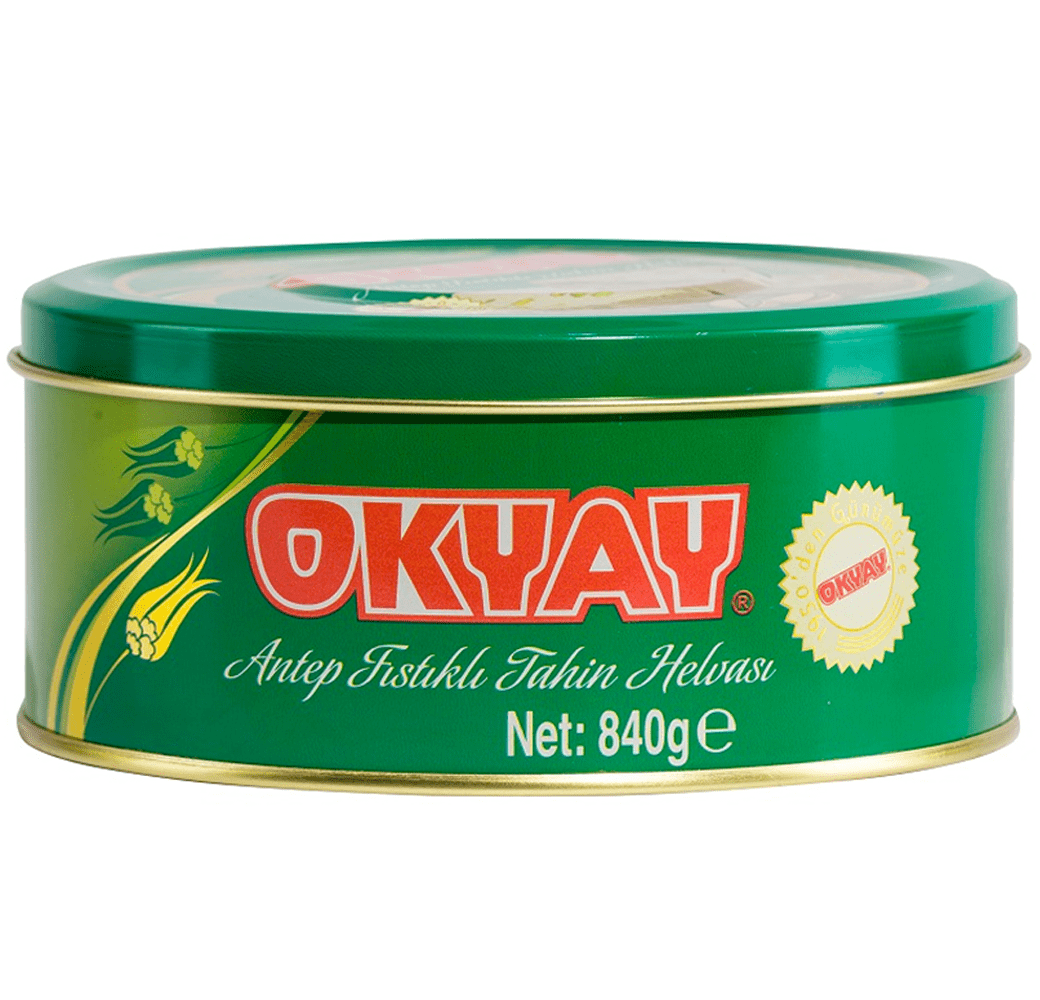

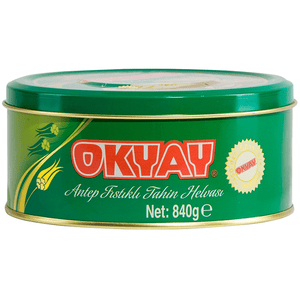
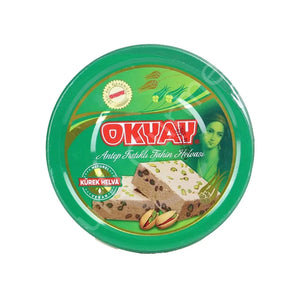
Okyay Pistachio Tahini Halva in a Tin – 840g
Selling fast! 12 people have this in their carts.
Guarantee Safe Checkout
Okyay Pistachio Tahini Halva – 840g Tin
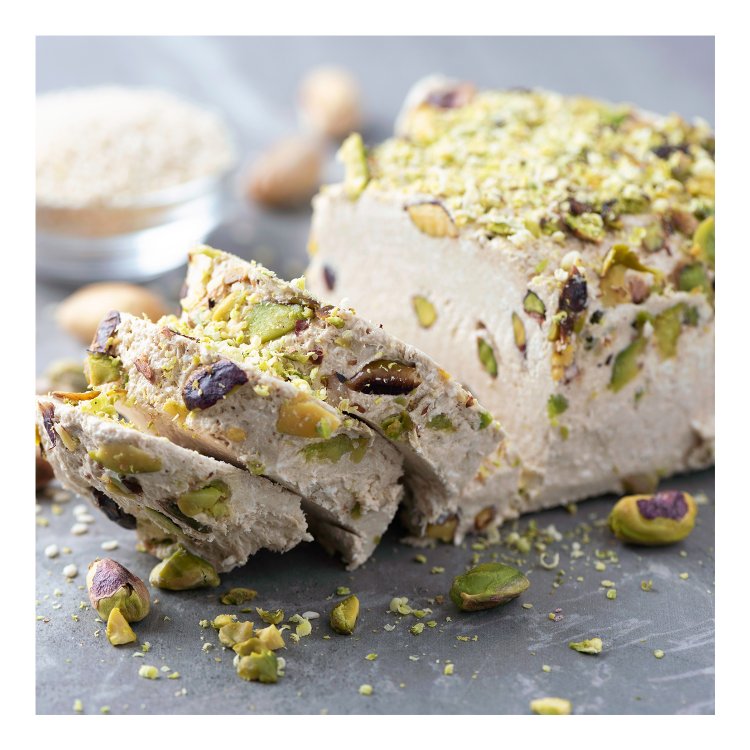
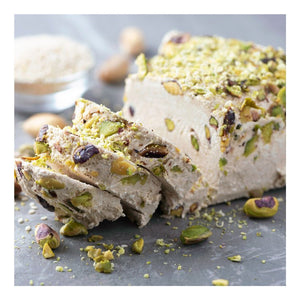
Halva made this way is becoming rare. Okyay, a Turkish confectionery house producing since 1948, still makes it without glucose syrup, without preservatives, and without shortcuts. This 840g tin holds a full slab of tahini halva — sesame paste and sugar beaten together the traditional way, with soapwort extract for aeration, and threaded through with pistachios from Gaziantep (Antep), the same southeastern Turkish city whose pistachio paste holds EU Geographical Indication status. The nuts are vivid green, distinctly flavoured, and not interchangeable with generic pistachios.
The texture is the thing. Tahini halva has a structure that no other confection replicates: a firm, fibrous slab that yields cleanly under a knife, then softens and melts on the tongue into a dense, nutty sweetness with a long sesame finish. The pistachio pieces interrupt that richness with a buttery crunch. It is filling in the way that very good food is filling — a small slice satisfies completely.
How to serve it: Slice straight from the tin at room temperature. Tahini halva is traditional at the Turkish breakfast table alongside white cheese and olives, though it moves equally well to the end of a meal, to a cheese board, or alongside strong coffee or black tea. Because the tin holds 840g, it is sized for a household, for gifting, or for sharing at a gathering — the lid reseals and the halva keeps well at room temperature.
What sets this tin apart:
- Made by Okyay — a Turkish producer with more than 75 years of continuous halva production since 1948
- Antep pistachios — distinctively flavoured, grown in Gaziantep province
- No glucose syrup — the sweetness comes from sugar and sesame
- No preservatives — the product is sealed in a tin, which is the preservation
- 840g format — substantial enough for regular use or as a considered gift
Tahini halva is one of the few confections that keeps its character almost unchanged in any kitchen — partly because it keeps, and partly because the flavour is genuinely hard to replicate. This tin is the larger format: once opened it lasts on the counter, and a household goes through it slowly.


